About three years ago, Martha Ferguson got up at 3:30 in the morning at her place in Old Snowmass to look at Jupiter and Venus hanging near a sliver of moon. She never saw them. Two columns of light from a ranch about a quarter mile away washed out the whole eastern sky. She has lived here since 1984, and that single fixture, on a property she could not have walked to in ten minutes, was enough to erase the view she had built a house around.
That story is the reason this valley now carries a certification most of Colorado does not. It is also the reason Thursday night matters more here than it does almost anywhere else in the Roaring Fork. On the evening of August 27, the brightest object in your sky switches itself off. A full moon is the single largest source of light pollution any of us deal with on a clear night, and for roughly two hours it will be gone.
What Actually Happens Overhead On Thursday
This is a partial lunar eclipse, but only on a technicality. NASA and Sky & Telescope put roughly 93% of the moon's diameter inside Earth's umbra at maximum. Timeanddate and the Old Farmer's Almanac measure the covered face of the disk and land at 96.2%. Either way, what you see is a nearly total eclipse: a dark, coppery moon with a thin bright rind along one edge. It is the deepest lunar event North America gets this year, and after it the Western Hemisphere waits until June 2029 for a full blood moon.
All times below are Mountain Daylight Time on the evening of Thursday, August 27.
| Stage | Time (MDT) | What you'll see |
|---|---|---|
| Partial phase begins | 8:33 p.m. | A dark bite forms on one limb of a low, rising moon |
| Maximum eclipse | 10:12 p.m. | Nearly the full disk in shadow, orange to copper, one silver sliver left |
| Moon leaves the umbra | 11:52 p.m. | Brightness returns; the last penumbral shading fades within about 45 minutes |
Here is the local wrinkle. At 8:33 the moon is still very low in the east, and Old Snowmass has a great deal of terrain in that direction. Depending on where you stand along Snowmass Creek Road or Capitol Creek Road, first contact may happen behind a ridge you cannot see over. Maximum at 10:12 is the reliable target. Plan around it rather than around the opening bell, and give yourself elevation and an open eastern horizon if you want the whole sequence.
No equipment is required and no filters are needed. A lunar eclipse is entirely safe to watch with your eyes. Binoculars make the shadow's curve across the lunar surface sharper, and a blanket matters more than a telescope does at 7,500 feet in late August.
The Two Hours Nobody Plans For
Most eclipse coverage stops at the moon. The better reason to be outside on Thursday is what happens to everything else.
On an ordinary full-moon night, the Milky Way is simply not available here. The moon overwhelms it. During the deep phase of this eclipse, with 93% or more of that light removed from the sky, you get something close to new-moon conditions on a night the calendar says is full. The photograph Pete McBride made of the Milky Way over Capitol and Daly, the one that has done more to explain this place to outsiders than any brochure, describes the kind of sky that should be briefly available between roughly 9:30 and 11:30 p.m.
That window is the whole argument for why the lighting work here was worth doing. Ann Driggers, who shoots night skies across this valley, has pointed out that nearly all of her images contain light pollution from Aspen, Snowmass Village, Basalt, and on certain aspects even Vail. Old Snowmass and Snowmass Canyon read as the dark gap between those glows. Thursday, that gap gets deeper for two hours, and whatever your neighbors have left burning is the only thing standing between you and the view.
Where People Actually Stand
You do not need to leave the valley floor. Old Snowmass at 7,500 feet is darker than the top of Aspen Mountain, which is where the 10th annual Stars Above Aspen astronomy night drew a crowd on August 10 with ACES and a planetarium dome at 11,212 feet. That event is worth attending for the telescopes and the company. It is not where the darkest sky in this county is.
A few practical notes on the usual spots:
- Capitol Creek Road (CR 9). The first five miles from the three-way intersection with Snowmass Creek Road are paved. Pull-offs past that point open onto meadow with a genuine horizon. The road turns to dirt and climbs, and the Forest Service is blunt that it is slick when wet.
- The Hay Park Trail horse-trailer parking area, about 1.2 miles past the end of the pavement, is the most obvious flat ground with room to turn around in the dark.
- The BLM meadow roughly 2.25 miles below the Capitol Creek Trailhead is where people without four-wheel drive are told to leave vehicles. The last mile above it is a 4WD road and not a place to discover your clearance at 11 p.m.
- Gates and cattle. The lower and middle stretches of the Capitol Creek Trail cross grazing ground. If you open a gate, close it.
- The Monastery Road turnoff. The wooden sign off Capitol Creek Road still marks it, but the ground behind it changed hands on December 15, 2025, when St. Benedict's roughly 3,700 acres sold for $120 million, the highest-priced residential transaction in Pitkin County's history. The road was still open to walkers in January and the new owner may restrict that at any point. Treat it as private and park elsewhere.
Fire Restrictions Change The Kit
The White River National Forest has been under Stage 2 fire restrictions since June 26, 2026. No campfires and no charcoal anywhere on the forest, including developed campgrounds and recreation sites. Gas-powered stoves are still allowed, which means the thermos and the propane burner are in and the fire ring is out. Pitkin County sets its own stage separately and adjusts it through the season, so check pitkinemergency.com before you plan anything involving flame on private ground.
The upside of a fire ban on eclipse night is that nobody is staring into a bright fire and destroying their night vision for twenty minutes at a stretch. Give your eyes a genuine half hour to adjust and keep phone screens dimmed and face-down.
If you are out past midnight, the Old Snowmass Market at the Highway 82 and Snowmass Creek Road junction opens at 6 a.m. Monday through Friday, 7 a.m. Saturday and 8 a.m. Sunday. Javier González-Bringas and Laura Maine turned that gas station into a working kitchen years ago, and the 6:30 to 9:30 a.m. stretch is its busiest hour for a reason.
The Part That Outlasts Thursday
The eclipse is a two-hour event. The certification behind it is permanent, and it is the actual story of this neighborhood.
In February 2026, DarkSky International certified Old Snowmass as an International Dark Sky Community, the eighth in Colorado and the first in this valley. It joins Westcliffe and Silver Cliff, Norwood, Nucla and Naturita, Ridgway, Crestone, Paonia, and Breckenridge. Ferguson brought the idea to the Snowmass Capitol Creek Caucus, the neighborhood nonprofit established in 1974, and founded WildSky Old Snowmass with four other caucus members. Pitkin County adopted a new lighting code in 2025, its first rewrite since 2006, with a specialized overlay written specifically for Old Snowmass and a provision requiring most exterior lights to go dark starting at 10 p.m.
"The most important thing I want to get out there is we're not saying you can't have lights. What we're saying is be smart about your lights," Ferguson told The Aspen Times. "Unlike many other forms of pollution, light pollution is reversible."
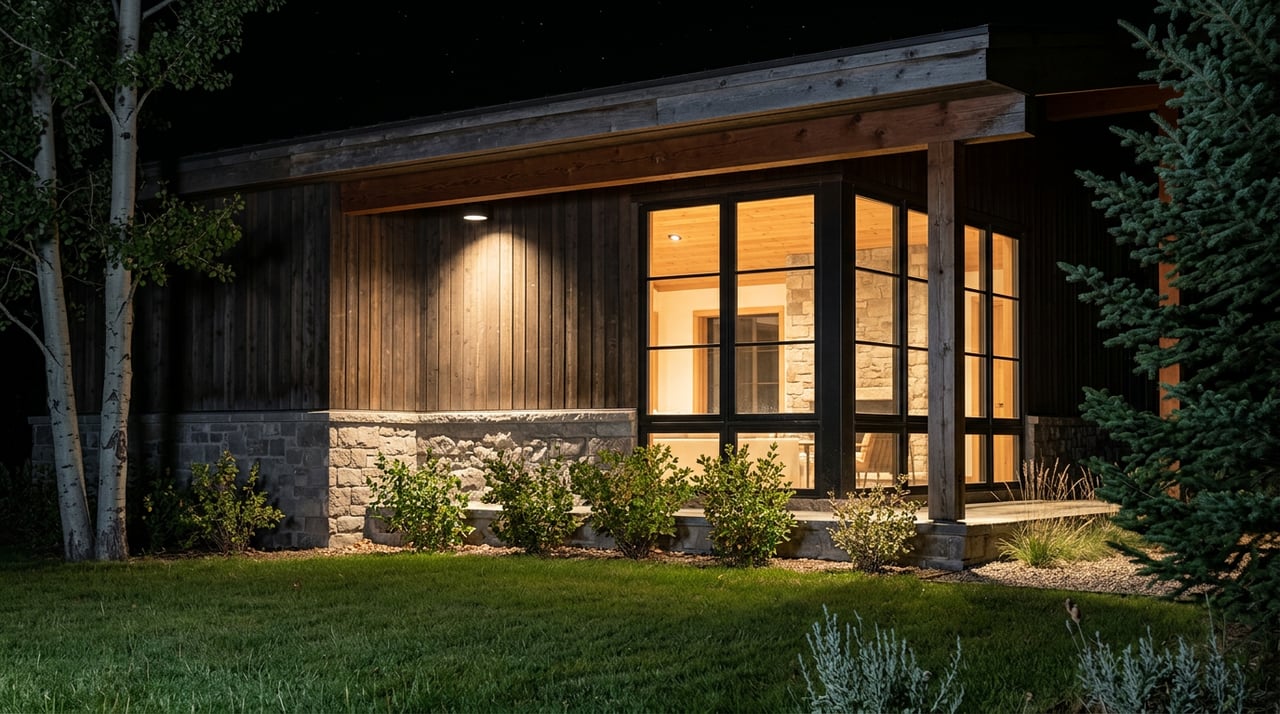
Enforcement here is complaint-based. No inspector drives Capitol Creek Road at midnight looking for uncapped floodlights. That makes this closer to how a ditch or a shared road gets maintained than to how a zoning rule gets applied: it works because neighbors participate, and it degrades the moment they stop. Commissioner Jeffrey Woodruff, who represents this district, tied it directly to the ground itself, calling the Snowmass and Capitol Creek valleys critical wildlife habitat and describing the night sky as complementary to the conservation easements and wilderness additions already in place. Elk and mule deer herds move through this valley on a regular schedule. They do it in the dark.
The Snowmass Capitol Creek Caucus has held its annual picnic and star party at Buttercup Ranch each September for years, and it remains the most direct way to meet the people who did this work. If you own here, you are already a member of the caucus. That is how it is structured.
Thursday is the demonstration. Walk outside at ten, look east, and notice how much sky comes back when one light source goes out. Then look at your own porch.
At Dayna + Mandy, we spend as much time on what a property's setting protects as on what it contains, because in this valley the two are the same asset. If you are weighing what a place in Old Snowmass holds over the long term, I would welcome the conversation. Start a private consultation.